
Vous êtes-vous déjà demandé comment transformer une simple feuille de métal en un boîtier complexe, durable et parfaitement intégré ? Que vous conceviez la prochaine génération de dispositifs médicaux ou des machines automatisées, le boîtier externe est tout aussi crucial que l’électronique interne. Il détermine la gestion thermique, l’intégrité structurelle et la durée de vie globale du produit.
Chez Huapusheng (HPS), nous sommes convaincus que la maîtrise du processus de fabrication permet aux équipes d'ingénierie de concevoir des produits plus performants et plus économiques. Explorons ensemble les principaux procédés de fabrication de tôlerie qui donnent vie aux modèles CAO 3D complexes.
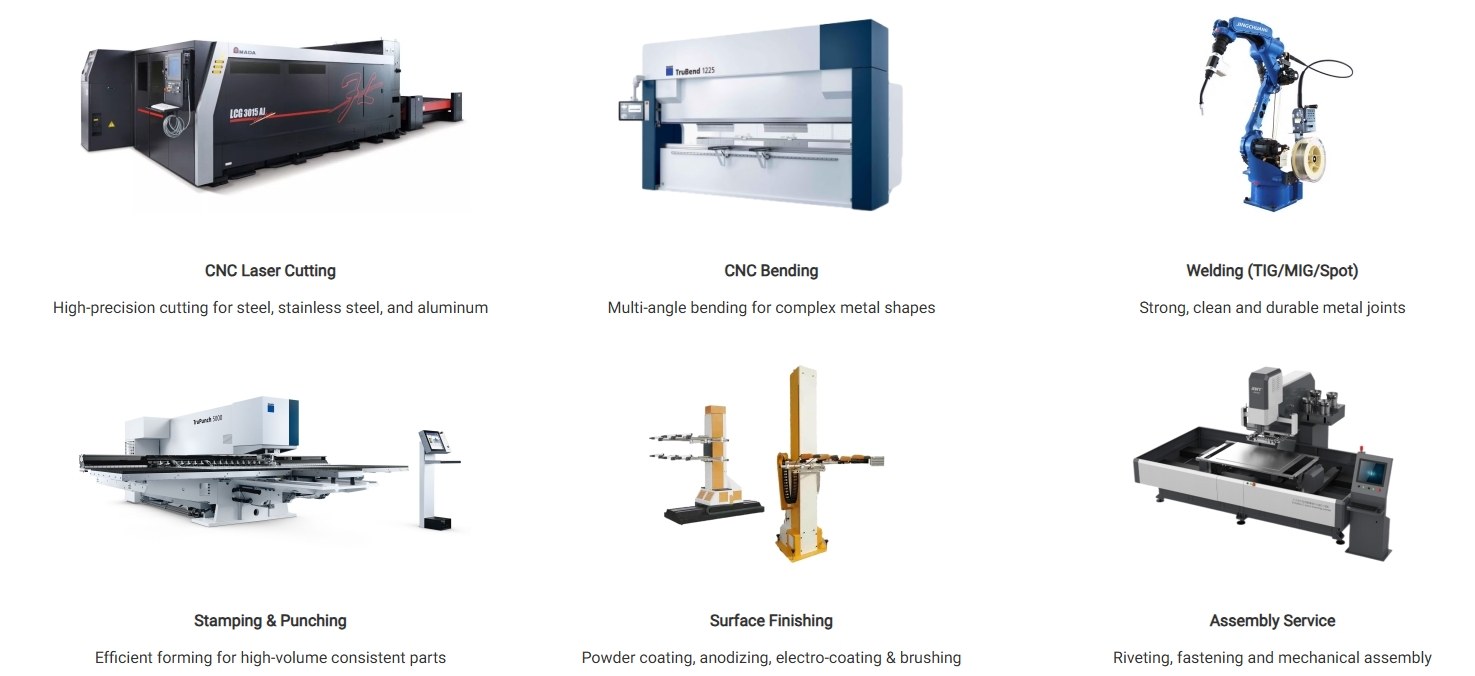
Le processus commence par le découpage, qui consiste à découper la tôle métallique (aluminium, acier inoxydable ou acier laminé à froid, par exemple) pour lui donner sa forme de base. Les découpeuses laser à fibre haute puissance modernes découpent le métal avec une vitesse et une précision exceptionnelles, laissant des bords lisses qui ne nécessitent qu'un ébavurage minimal.
Pour les pièces nécessitant des perforations complexes, des persiennes sur mesure ou des éléments emboutis, on utilise des poinçonneuses CNC. Ces machines créent efficacement des motifs complexes en une seule opération, garantissant une circulation d'air optimale pour les composants électroniques générant de la chaleur.
Une fois la pièce brute préparée, elle est acheminée vers les presses plieuses. Le pliage CNC utilise un logiciel de pointe pour calculer avec précision les déductions de pliage et les coefficients de retour élastique en fonction de l'épaisseur et de la limite d'élasticité du matériau. La précision dimensionnelle est ici impérative.
Par exemple, lors de la fabrication d'un Châssis rackable en tôle sur mesure Dans les centres de données, le respect de tolérances de pliage extrêmement strictes est indispensable pour garantir un alignement parfait entre les entretoises internes de la carte mère et les rails de guidage externes dans une baie serveur standard. Un écart d'un millimètre seulement peut entraîner des échecs d'installation.
Les géométries complexes ne peuvent pas toujours être pliées à partir d'une seule feuille continue. Les conceptions composées de plusieurs pièces exigent des techniques d'assemblage précises. Selon le matériau et les exigences mécaniques, les techniciens utilisent le soudage TIG (Tungsten Inert Gas), le soudage MIG (Metal Inert Gas) ou le soudage laser de pointe.
Réaliser une soudure à pénétration profonde avec une déformation thermique minimale est une compétence spécialisée. Cette intégrité structurelle est absolument vitale lors de la construction d'un Boîtier pour équipement industriel robuste, qui doit supporter un poids interne important et résister aux fortes vibrations, à la poussière et aux chocs typiques des environnements industriels.
Les dernières étapes sont axées sur la protection, l'esthétique et la préparation à l'assemblage. Des traitements de surface comme le revêtement en poudre industriel, l'anodisation transparente ou colorée et le brossage fin préviennent la corrosion et confèrent un aspect haut de gamme.
De plus, l'intégration directe de la quincaillerie dans la tôle (par exemple, l'insertion d'écrous PEM, de goujons à tête fraisée ou de vis imperdables) transforme un simple boîtier métallique en un composant prêt à être assemblé. Pour les équipements de test sensibles, la finition d'un Boîtier d'instrument en aluminium de haute précision implique souvent une combinaison de brossage lisse, de masquage conducteur précis pour la mise à la terre électrique et d'étiquettes permanentes gravées au laser pour une identification claire des ports.
Pour vous aider à comprendre les limites techniques de la fabrication moderne de tôles, voici un aperçu des paramètres et capacités de traitement standard :
| Processus de fabrication | Capacités et options techniques |
|---|---|
| Options de matériaux | Aluminium (5052/6061), acier inoxydable (304/316L), acier laminé à froid, cuivre |
| Précision de coupe | Précision de découpe laser jusqu'à +/- 0,05 mm ; poinçonnage CNC pour persiennes sur mesure. |
| Capacité de formation | Presses plieuses CNC multi-axes traitant des épaisseurs de 1,0 mm à plus de 5,0 mm. |
| Insertion de matériel | Écrous PEM préinstallés, rivets aveugles, vis imperdables et entretoises sur mesure. |
| Traitements de surface | Sablage, brossage fin, anodisation, revêtement en poudre, film chimique (alodine). |
Fabrication d'un boîtier métallique de haute qualité La fabrication de produits repose sur un équilibre subtil entre machines lourdes, ingénierie de précision et savoir-faire artisanal. La maîtrise des procédés de découpe laser, de pliage CNC, de soudage spécialisé et de traitement de surface permet de concevoir des produits plus robustes, plus faciles à assembler et d'une esthétique remarquable. Lorsque vous êtes prêt à passer d'un modèle CAO 3D à un prototype physique, collaborer avec un atelier de fabrication expérimenté comme HPS vous garantit une parfaite concrétisation de votre vision.
 Obtenez un devis dès maintenant


 IPv6 RÉSEAU PRIS EN CHARGE
Laissez un message
Numériser vers Wechat :

Numériser vers WhatsApp :

Hi! Click one of our members below to chat on

 English
 Français
 Deutsch
 Русский
 Italiano
 Español
 Nederland
 日语
日语 한국어
한국어 Svenska